

Photos: gailhampshire from Cradley, Malvern, U.K, CC BY 2.0 · Johannes K Becker, CC BY-SA 3.0 · gailhampshire from Cradley, Malvern, U.K, CC BY 2.0 · Jon Lean from Bristol, United Kingdom, CC BY-SA 2.0 · Elena Tatiana Chis, CC BY-SA 4.0
About
This seven-day private loop from Marrakech links Morocco's two desert regions. You cross the High Atlas to Ait Ben Haddou, follow the Road of a Thousand Kasbahs through the Dades and Todra gorges, and spend two nights at the Erg Chebbi dunes in Merzouga. You then return a different way: west along the rim of the Sahara to Zagora and north through the palm groves of the Draa Valley to Ouarzazate, before recrossing the Atlas to Marrakech. You never drive the same road twice until the last pass, and you see the high dunes of the Erg Chebbi as well as the Draa, Morocco's longest oasis. The days are planned so the driving never takes over. You sleep at Ait Ben Haddou to walk the ksar at sunset. The night in the Dades valley breaks the long road east. Your second night at Merzouga gives a full day in the desert, with sunrise, a 4x4 loop to a nomad family and the Gnawa village of Khamlia, and time to rest. The return through Zagora and the Draa adds things most desert tours miss: rock engravings near Tazzarine, the kasbahs of Nkob, the Koranic library of Tamegroute and the old kasbah of Tamnougalt. AT A GLANCE • Duration: 7 days, 6 nights • Start and finish: Marrakech (hotel, riad or airport) • Type: private tour with your own driver; local guide in Ait Ben Haddou • Total distance: about 1,400 km; most days 4–6 hours on the road with stops, and Day 4 with almost none • Nights: Ait Ben Haddou, Dades valley, Erg Chebbi camp, Merzouga (camp or dune-side hotel), Zagora, Ouarzazate • Meals: dinner on Days 1–6 and breakfast on Days 2–7 • Activity level: easy WHAT YOU SEE • The Tizi n'Tichka pass, the Ounila valley and the Glaoui kasbah of Telouet. • Ait Ben Haddou at sunset. • Ouarzazate, Skoura's Kasbah Amridil and the Valley of Roses. • The Dades valley hairpins and the Todra Gorge. • The Erg Chebbi dunes at sunset and sunrise, Khamlia and a nomad family. • The pre-Saharan road via Alnif, Tazzarine and the kasbahs of Nkob. • Zagora, the library and potters of Tamegroute, and the Draa palm groves. • The kasbah of Tamnougalt, Agdz and the Atlas film studios. WHY THIS ROUTE WORKS Most seven-day desert tours from Marrakech go out and back on the same road, or add Zagora only as a one-night detour. This loop goes out through the gorges and returns through the Draa, so every day brings new scenery. Two nights at the dunes mean you see the Sahara by day as well as at sunset and sunrise. The overnight stops are spaced so that no single day is longer than about six hours of driving. WHO WILL ENJOY IT First-time visitors based in Marrakech who want the full south in a week, couples and families who want two desert nights without rushing, photographers, and travellers interested in the history of the caravan routes, the kasbahs and the oases. WHO MIGHT PREFER ANOTHER TOUR If you are already in Ouarzazate, the 7-day Ouarzazate to Marrakech Sahara trip drives the same loop in the other direction. If you want to end in Fes instead of returning to Marrakech, see the 10-day Marrakech to Fes tour via the Sahara and the kasbahs. PRACTICAL INFORMATION Pack layers: the Atlas passes and desert nights are cold from November to March, and days in the south are hot from May to September. Bring a hat, sunscreen, a warm top for the camp and a small overnight bag, since your main luggage stays in the vehicle on the dune nights. Lunches, drinks and entrance fees (usually 20–100 dirhams) are not included. Pick-up is at your Marrakech hotel or riad; inside the medina a porter carries your bags to the nearest road.
from €618 per person
Select date and travelers
Duration
7 days
Starts in
Marrakech
Ends in
Marrakech
Private tourOnly your group, with your own driver and vehicle. Your booking is confirmed straight away.
Free cancellationFull refund if canceled up to 24 hours before the start of the experience (local time)
Reserve now and pay laterReserve your spot while maintaining flexibility.
Lowest price guaranteedFound a lower price online? We'll refund the difference.
Included
Everything included in your package
Standard
Private tour
- Pick-up and drop-off at your hotel or riad
- Private air-conditioned vehicle for the whole trip
- Professional English or French-speaking driver
- Comfortable hotels or riads with private bathroom
- Daily breakfast and dinner
- Bottled water during the trip
LuxuryUpgrade
Private tour
- Pick-up and drop-off at your hotel or riad
- Private premium vehicle for the whole trip
- Professional English or French-speaking driver
- Charming riads, boutique hotels and luxury desert camp
- Daily breakfast and dinner
- Bottled water and snacks during the trip
- Flexible departure times
Itinerary: 7 days, day by day
Highlights
- Khamlia
- Tazzarine
- Draa Valley
- Marrakech
- Ait Ben Haddou
- Dades Valley
- Todra Gorge
- Merzouga
| Day | Route | Overnight | On the road |
|---|---|---|---|
| 1 | Marrakech - Ait Ben Haddou | Ait Ben Haddou | 130 km · 2 h |
| 2 | Ait Ben Haddou - Dades Valley | Dades Valley | 160 km · 2.5 h |
| 3 | Dades Valley - Todra Gorge - Merzouga | Merzouga | 250 km · 3.5 h |
| 4 | A day in the Sahara | Merzouga | — |
| 5 | Merzouga - Zagora | Zagora | 250 km · 3.5 h |
| 6 | Zagora - Draa Valley - Ouarzazate | Ouarzazate | 160 km · 2.5 h |
| 7 | Ouarzazate - Marrakech | — | 170 km · 2.5 h |
Day 1: Marrakech to Ait Ben Haddou
About 130 km · 2 h on the road
What to expect: from Marrakech over the High Atlas on the Tizi n'Tichka pass, a detour through the Ounila valley to the kasbah of Telouet, and a sunset walk to the top of Ait Ben Haddou. Your driver collects you in Marrakech after breakfast. The road crosses the Haouz plain and starts to climb through red-earth villages, walnut groves and stands of juniper. It reaches the Tizi n'Tichka, at about 2,260 m the highest major road pass in Morocco. Just beyond the summit you leave the main highway for the quieter road to Telouet. This was the seat of the Glaoui family, who controlled the caravan route over the Atlas until the 1950s. Their kasbah is now largely ruined, but its reception rooms still have zellige tilework, carved plaster and painted cedar ceilings. From Telouet the road follows the Ounila valley south, past cliff-side villages, salt workings and terraced fields, to Ait Ben Haddou. This ksar of earthen houses and towers piled up a hillside above the river has been a UNESCO World Heritage Site since 1987 and has featured in many films. In the late afternoon, once the day visitors have gone, a local guide walks you across the river and up through the lanes to the ruined granary at the top for sunset. SCHEDULE (times are estimates) 08:30 – Pick-up in Marrakech. 11:00 – Tizi n'Tichka pass and viewpoints. 12:00 – Telouet kasbah (about 1 hour); lunch (not included). 14:30 – Ounila valley. 16:00 – Arrival in Ait Ben Haddou. 17:00 – Guided walk to the top of the ksar for sunset. 19:30 – Dinner at the hotel. GOOD TO KNOW • About 230 km including the Telouet detour. • The pass road has many bends; take something for motion sickness if needed. INCLUDED: driver, local guide in Ait Ben Haddou, hotel with dinner and breakfast. NOT INCLUDED: entrance fees, lunch, drinks, tips. Overnight: hotel or kasbah guesthouse in Ait Ben Haddou. Meals: dinner.
Day 2: Ait Ben Haddou to the Dades valley
About 160 km · 2.5 h on the road
What to expect: east along the Road of a Thousand Kasbahs through Ouarzazate, Skoura and the Valley of Roses to the red rocks of the Dades valley. After breakfast you drive half an hour to Ouarzazate, the desert gateway and film town, for a stop at the Taourirt Kasbah. This large earthen residence of the Glaoui family has painted ceilings in its upper rooms. Beyond the town the road runs east between the High Atlas and the Jebel Saghro. At Skoura, a palm oasis dotted with old fortified houses, you visit the Kasbah Amridil, a seventeenth-century kasbah that once appeared on the 50-dirham note, with its olive press, kitchen and tower rooms. At Kelaat M'Gouna, in the Valley of Roses, Damask roses grow in hedges between the fields and are distilled into rose water each May. Shops sell rose water, oils and soaps all year. At Boumalne you turn north up the Dades valley. You pass the rounded red rock formations known as "monkey fingers" and the kasbahs of Ait Youl, then climb to the Tisdrine hairpins for the classic view down the road. Your hotel sits by the river. SCHEDULE (times are estimates) 09:00 – Depart Ait Ben Haddou. 09:45 – Ouarzazate: Taourirt Kasbah (about 45 minutes). 11:30 – Skoura and the Kasbah Amridil (about 1 hour). 13:00 – Lunch (not included). 14:30 – Valley of Roses, Kelaat M'Gouna. 16:00 – Dades valley, "monkey fingers" and the Tisdrine hairpins. 17:30 – Hotel in the Dades valley; dinner. GOOD TO KNOW • About 190 km in short stages. • The rose harvest is in late April and May; a rose festival is held in Kelaat M'Gouna in May. • The Dades valley is cool at night; keep a warm layer handy. INCLUDED: driver, hotel with dinner and breakfast. NOT INCLUDED: entrance fees, lunch, drinks, tips. Overnight: hotel in the Dades valley. Meals: breakfast, dinner.
Day 3: Todra Gorge to Merzouga
About 250 km · 3.5 h on the road
What to expect: a walk in the Todra Gorge, then east past khettara wells and oases to Merzouga, and a sunset camel trek into the Erg Chebbi dunes for a night in camp. The morning road follows the foot of the Atlas to Tinghir, a large oasis town spread along a green valley under red hills. Just north of town the Todra Gorge narrows to a slot about 10 m wide between limestone walls around 300 m high. Walk along the stream through the narrowest part, where climbers are often on the rock. A walk through the palm grove and villages with a local guide can be added. The road then continues east through Tinejdad and past the lines of khettara wells, underground channels that carried water to the oases for centuries. You reach Erfoud, known for fossil-rich black marble, and then Merzouga, where the dunes of the Erg Chebbi rise on the horizon. They form a sea of orange sand about 22 km long and up to around 150 m high. Leave your main luggage in the vehicle and ride a camel for about 90 minutes into the dunes. Climb a ridge for sunset and reach camp for dinner, drumming around the fire and a sky full of stars. SCHEDULE (times are estimates) 08:30 – Depart the Dades valley. 09:30 – Todra Gorge walk (about 1 hour). 11:00 – Tinghir; lunch on the way (not included). 15:30 – Arrival in Merzouga. 17:00 – Camel trek into the dunes (about 1.5 hours). 19:00 – Camp; dinner. GOOD TO KNOW • About 280 km, with plenty of stops. • Pack a small bag for the camp: warm layer, torch, toothbrush, charger. Camps with private bathrooms are available on request. • If you would rather not ride, a 4x4 can take you to the camp. INCLUDED: driver, camel trek, camp with dinner and breakfast. NOT INCLUDED: lunch, drinks, tips. Overnight: desert camp in the Erg Chebbi. Meals: breakfast, dinner.
Day 4: A day in the Sahara
What to expect: a full day in the Sahara: sunrise on the dunes, a 4x4 loop to a nomad family, the Gnawa village of Khamlia and the desert's fossil beds, then free time and a second sunset. Wake before dawn and climb the dune behind the camp to watch the sun rise over the Erg Chebbi. Then ride back to Merzouga for breakfast and a shower. Late in the morning your driver takes you on a 4x4 loop around the dunes. You visit a nomad family who still keep goats and camels in the stony hamada and will usually offer tea in their tent. In Khamlia, whose families descend from people brought across the Sahara from West Africa, musicians play Gnawa music with iron castanets and drums in a simple house. Depending on the season and recent rain, the loop can also take in the seasonal lake of Dayet Srji, where flamingos sometimes stop, and an old mining area where fossils lie on the surface. The afternoon is yours: rest by the pool, try sandboarding, or walk out to a high dune for the last light. SCHEDULE (times are estimates) 06:00 – Sunrise on the dunes; ride back to Merzouga. 08:00 – Breakfast. 10:00 – 4x4 loop: nomad family, Khamlia, fossils (about 3 hours). 13:00 – Lunch (not included). 15:00 – Free time; sandboarding or quad biking (optional). 18:00 – Sunset on the dunes. GOOD TO KNOW • Tonight you stay in a hotel at the edge of the dunes, usually with a pool. If you prefer a second night in the camp, tell us when booking. • Quad biking is paid locally; choose operators who keep away from the camps and the nomad areas. INCLUDED: driver and 4x4 loop, hotel at the edge of the dunes with dinner and breakfast. NOT INCLUDED: lunch, optional activities, drinks, tips. Overnight: hotel at the edge of the dunes in Merzouga (or the camp on request). Meals: breakfast, dinner.
Khamlia
Duration: About 45 minutes
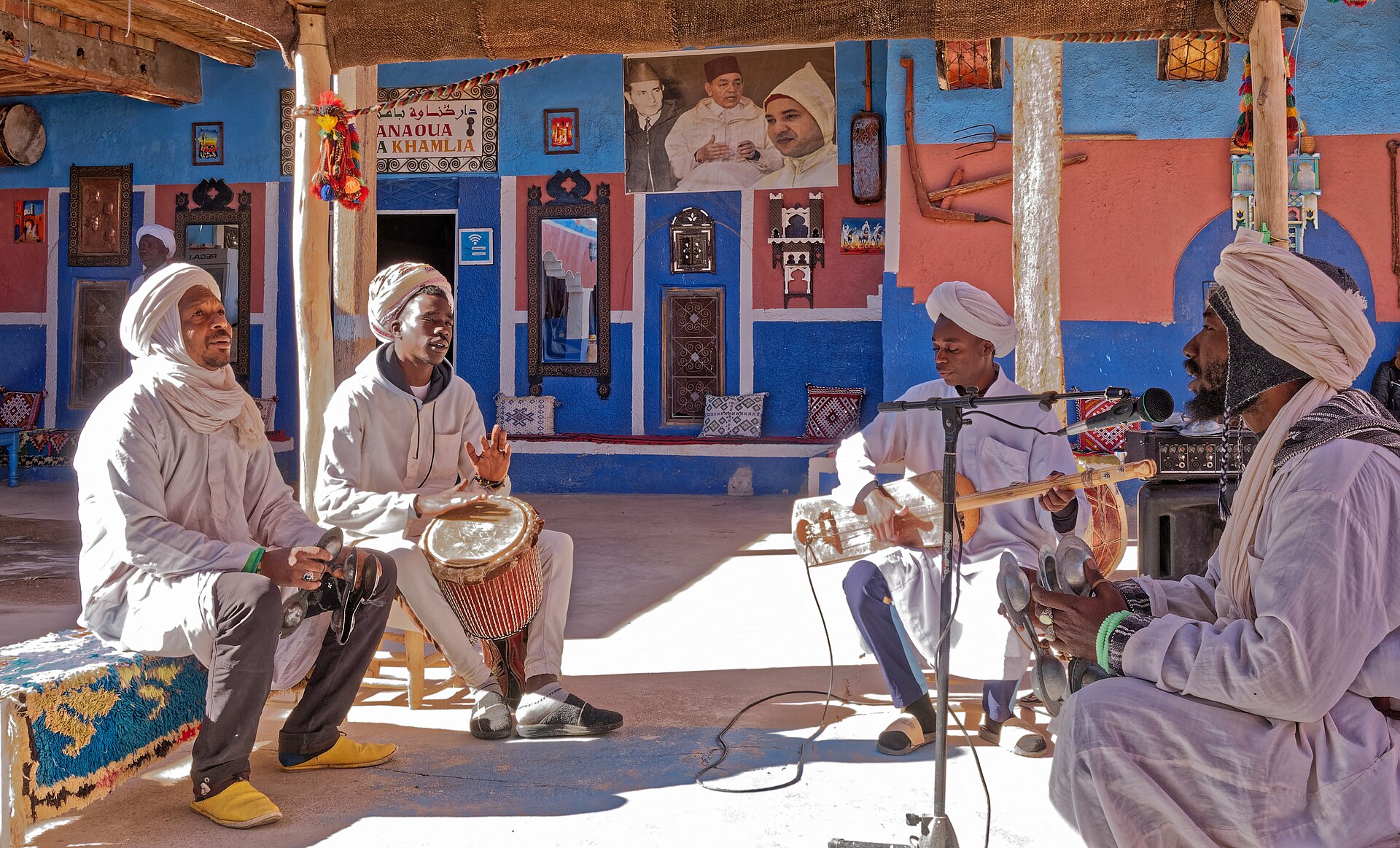
Gnawa music. Practical: contribution expected.
Day 5: Merzouga to Zagora
About 250 km · 3.5 h on the road
What to expect: west along the rim of the Sahara by a road few tours use, via Rissani, the trilobite workshops of Alnif, the rock engravings near Tazzarine and the kasbahs of Nkob, to Zagora. After breakfast you drive through Rissani, the old capital of the Tafilalt. The Alaouite dynasty that rules Morocco today came from here, and its market is busiest on Sundays, Tuesdays and Thursdays. The road then turns west between the Jebel Saghro and the Sahara, through black hamada, acacia and small oases. At Alnif, families have quarried and prepared trilobites for generations, and a workshop shows how the fossils are freed from the rock. Near Tazzarine a short track leads to the Ait Ouazik rock engravings, where prehistoric herders carved giraffes, antelopes and cattle from a time when this was savannah. Nkob, in the foothills of the Saghro, has dozens of earthen kasbahs, some restored as guesthouses, and makes a good stop for mint tea. In the late afternoon you join the Draa Valley at Tansikht and drive south through the palm groves to Zagora. The town is famous for its faded sign reading "Tombouctou 52 jours", the number of days a caravan took to reach Timbuktu. SCHEDULE (times are estimates) 08:30 – Depart Merzouga; Rissani. 10:30 – Alnif fossil workshop. 12:00 – Tazzarine and the Ait Ouazik engravings (optional); lunch (not included). 14:30 – Nkob kasbahs and mint tea. 17:00 – Arrival in Zagora. GOOD TO KNOW • About 300 km, the longest day of the tour, but on good tarmac with regular stops. • Bring water and snacks; services are sparse between Alnif and Nkob. INCLUDED: driver, hotel with dinner and breakfast. NOT INCLUDED: entrance fees, lunch, drinks, tips. Overnight: hotel or kasbah in Zagora. Meals: breakfast, dinner.
Tazzarine
Duration: About 45 minutes
Prehistoric rock engravings in the area. Practical: ask your driver.
Day 6: Draa valley to Ouarzazate
About 160 km · 2.5 h on the road
What to expect: the library and green pottery of Tamegroute, then north through the Draa palm groves to the kasbah of Tamnougalt, Agdz and Ouarzazate, with the Atlas film studios in the afternoon. Start with a short drive south to Tamegroute. Its zaouia keeps a library of old Korans and manuscripts on astronomy, medicine and law, some on gazelle-skin parchment. Nearby, potters fire the village's typical green-glazed ware in wood-fired kilns. Then turn north up the Draa Valley, Morocco's longest oasis, a ribbon of date palms, olive trees and fields between earthen villages that runs for roughly 200 km. At Tamnougalt you walk through the old kasbah of the local caïds, a maze of covered passages and courtyards above the river. Agdz, under the flat-topped Jebel Kissane, marks the end of the palm groves. From there the road climbs the Tizi n'Tinififft pass (about 1,660 m), where the rock is folded into bands of black, ochre and purple, and drops to Ouarzazate. In the afternoon, visit the Atlas Film Studios, where sets built for desert epics and biblical films still stand. SCHEDULE (times are estimates) 08:30 – Tamegroute: library and pottery cooperative (about 1 hour). 10:30 – Drive north through the Draa Valley. 12:00 – Kasbah of Tamnougalt (about 1 hour). 13:00 – Lunch in Agdz (not included). 15:30 – Atlas Film Studios, Ouarzazate (about 1 hour). 17:00 – Hotel in Ouarzazate; dinner. GOOD TO KNOW • About 210 km including the Tamegroute detour. • The library is a working religious foundation; dress modestly, and a small donation is customary. • Dates are harvested in October, the best time to buy them in the valley. INCLUDED: driver, hotel with dinner and breakfast. NOT INCLUDED: entrance fees and donations, lunch, drinks, tips. Overnight: hotel in Ouarzazate. Meals: breakfast, dinner.
Draa Valley
Duration: Drive
A 100 km oasis of date palms. Practical: dates in autumn.
Day 7: Ouarzazate to Marrakech
About 170 km · 2.5 h on the road
What to expect: back over the High Atlas on the Tizi n'Tichka pass to Marrakech, with stops at mountain viewpoints and an argan oil cooperative. After breakfast the road climbs from Ouarzazate past Amerzgane and the turn to Ait Ben Haddou into the High Atlas. The landscape changes from dry, mineral slopes to Berber villages, terraced fields and walnut trees as you cross the Tizi n'Tichka, at about 2,260 m, and wind down the northern side. A stop at a women's cooperative on the way down shows how argan kernels are cracked by hand and pressed into oil for cooking and cosmetics. You reach Marrakech in the early afternoon. Your driver takes you to your hotel or riad, with a porter for the last part inside the medina, or to the airport or station. SCHEDULE (times are estimates) 09:00 – Depart Ouarzazate. 11:00 – Tizi n'Tichka pass and viewpoints. 12:00 – Argan cooperative (about 30 minutes). 13:00 – Lunch in the mountains (not included). 14:30 – Arrival in Marrakech. GOOD TO KNOW • About 200 km, roughly 4 hours with stops. • The timing suits an evening flight from Marrakech; for an earlier flight, leave Ouarzazate earlier. • The pass road has many bends; take something for motion sickness if needed. INCLUDED: driver, drop-off in Marrakech. NOT INCLUDED: lunch, drinks, tips. Overnight: none (end of tour). Meals: breakfast.
Plan your trip
Best time to go
- March to May: the best season, warm days and green valleys.
- September to November: pleasant days and clear, starry desert nights.
- December to February: sunny days, but desert and mountain nights are cold (bring warm layers).
- June to August: very hot in the Sahara (often above 40 °C); early starts help.
Getting there
Make it yours
This is a private tour: we can add a night, change hotels or adjust the route to suit you.
Practical info
- Money: the Moroccan dirham (MAD). Cards work in cities and hotels; bring cash for villages, tips and souks.
- Plugs: type C and E (European), 220 V.
- Phone: a local SIM (Maroc Telecom, Orange or inwi) is cheap at the airport and works along the whole route.
- Visa: many nationalities (EU, UK, US, Canada, Australia) need none for up to 90 days. Check the rules for your passport before you go.
What to bring
- Comfortable shoes for the medinas and the dunes
- Warm layers for desert nights
- A scarf or hat, sunglasses and sunscreen
- Some cash in dirhams for tips and small purchases
- Clothes covering shoulders and knees for villages and religious sites
- Your passport (hotels ask for it at check-in)
Good to know
Cancellation policy
Full refund if you cancel at least 24 hours before the start. Cancellations less than 24 hours before are not refunded. If bad weather stops the tour, you get a new date or a full refund.
Accessibility
Not wheelchair accessible. Child seats or chairs available.
Frequently Asked Questions
Where does the tour start and finish?
It starts and finishes in Marrakech. Your driver collects you from your hotel or riad (or the airport) on Day 1 and drops you back, or at the airport or station, on Day 7.
Is the tour private?
Yes. The vehicle and driver are for you and your party only, so you can change stops and timings each day.
How many nights are in the desert?
Two nights at the Erg Chebbi dunes in Merzouga: the first in a camp among the dunes and the second in a hotel at the edge of the dunes (or the camp again if you prefer). You also sleep in Zagora, on the edge of the Sahara.
Which meals are included?
Dinner on Days 1 to 6 and breakfast on Days 2 to 7, so every night is half board. Lunches and drinks are not included; the driver stops at good local restaurants, where lunch usually costs 80–150 dirhams.
What is the desert camp like?
Berber-style tents among the dunes with proper beds, blankets, dinner and breakfast. Standard camps have shared bathrooms; camps with a private bathroom in each tent are available on request.
Do I have to ride a camel?
No. The ride takes about 90 minutes each way, but a 4x4 can take you to the camp instead.
How long are the drives?
Most days are 4–6 hours on the road with stops. Days 3 and 5 (about 280 and 300 km) are the longest; Day 4 has almost no driving.
Why go back via Zagora instead of the same road?
So that every day is new. The Draa Valley, Tamegroute, Tamnougalt and the road through Nkob show a different south – older oases, caravan towns and rock art – and the loop is barely longer than going back the way you came.
Is there a guide?
Your driver explains the places along the way and speaks English. A local guide leads the walk in Ait Ben Haddou, and local guides for the Todra palm grove or Tamnougalt can be added.
Are entrance fees included?
No. They are paid on the spot and are modest: kasbahs, the film studios and the library each cost about 20–100 dirhams.
Is it suitable for children and older travellers?
Yes. The pace is easy, the desert day breaks up the driving and the walks are short, apart from the steps in Ait Ben Haddou. Child seats are available on request.
When is the best time to go?
March to May and late September to November are the most comfortable. Winter is clear but cold at night, and the Tichka pass can see snow; June to August is very hot in the south.
Can the tour end somewhere other than Marrakech?
Yes. It can finish in Ouarzazate after Day 6, or you can continue north to Fes instead of returning; our 10-day Marrakech to Fes tour is built around that route.
How do I pay for this tour?
You can reserve with €20 now and pay the rest on the first day of the tour, or pay everything online when you book.
What is the cancellation policy?
Cancel at least 24 hours before the start for a full refund. If bad weather stops the tour, you get a new date or a full refund.
How far in advance should I book?
Spring (March to May) and autumn (September to November) are the busiest seasons, so book early for those months. You can reserve with €20 and still cancel for free up to 24 hours before.
Similar experiences
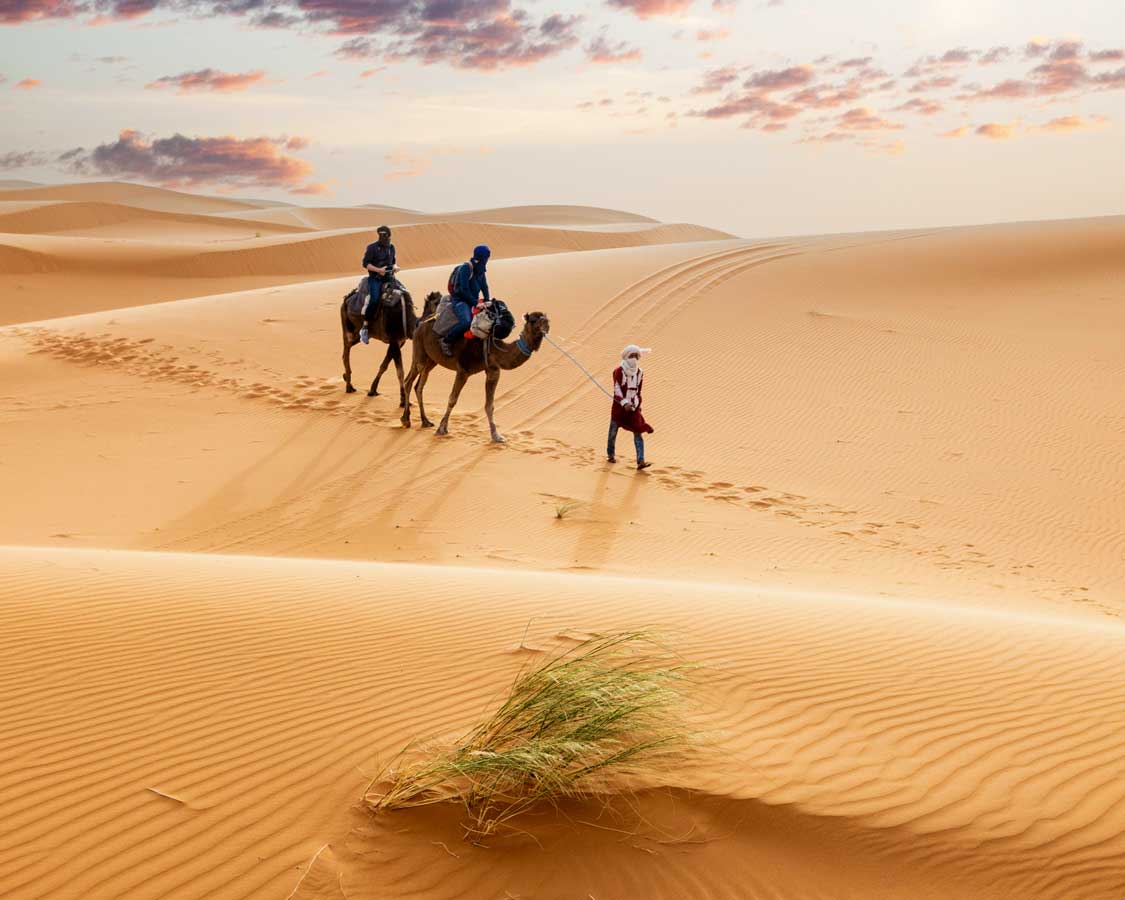 PopularMarrakech
3-Day Marrakech to Merzouga Desert Tour with Sahara Camp
5.0(5)
from €276 per person
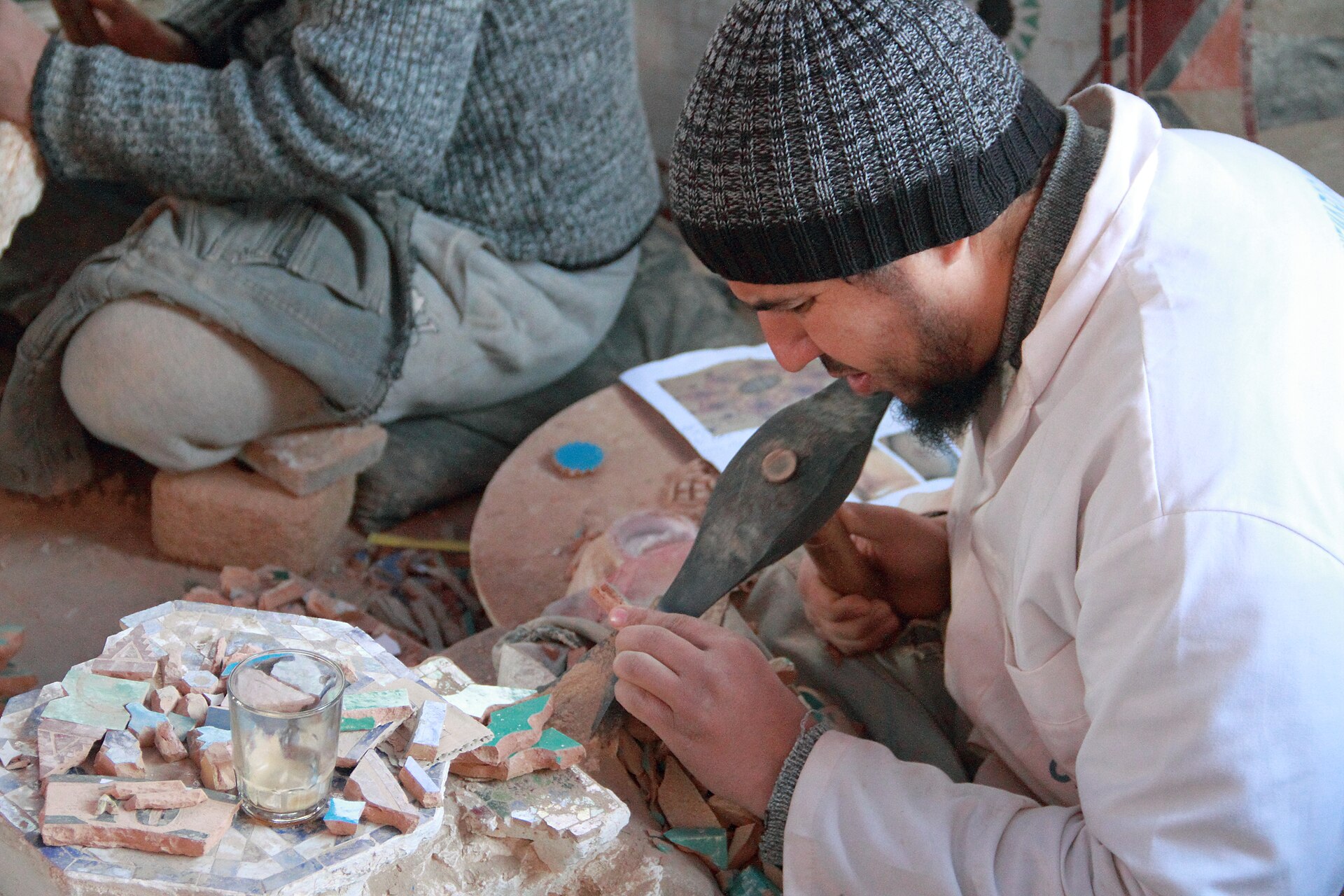 PopularMarrakech
Morocco Itinerary 10 Days: The Grand Loop from Marrakech
from €908 per person
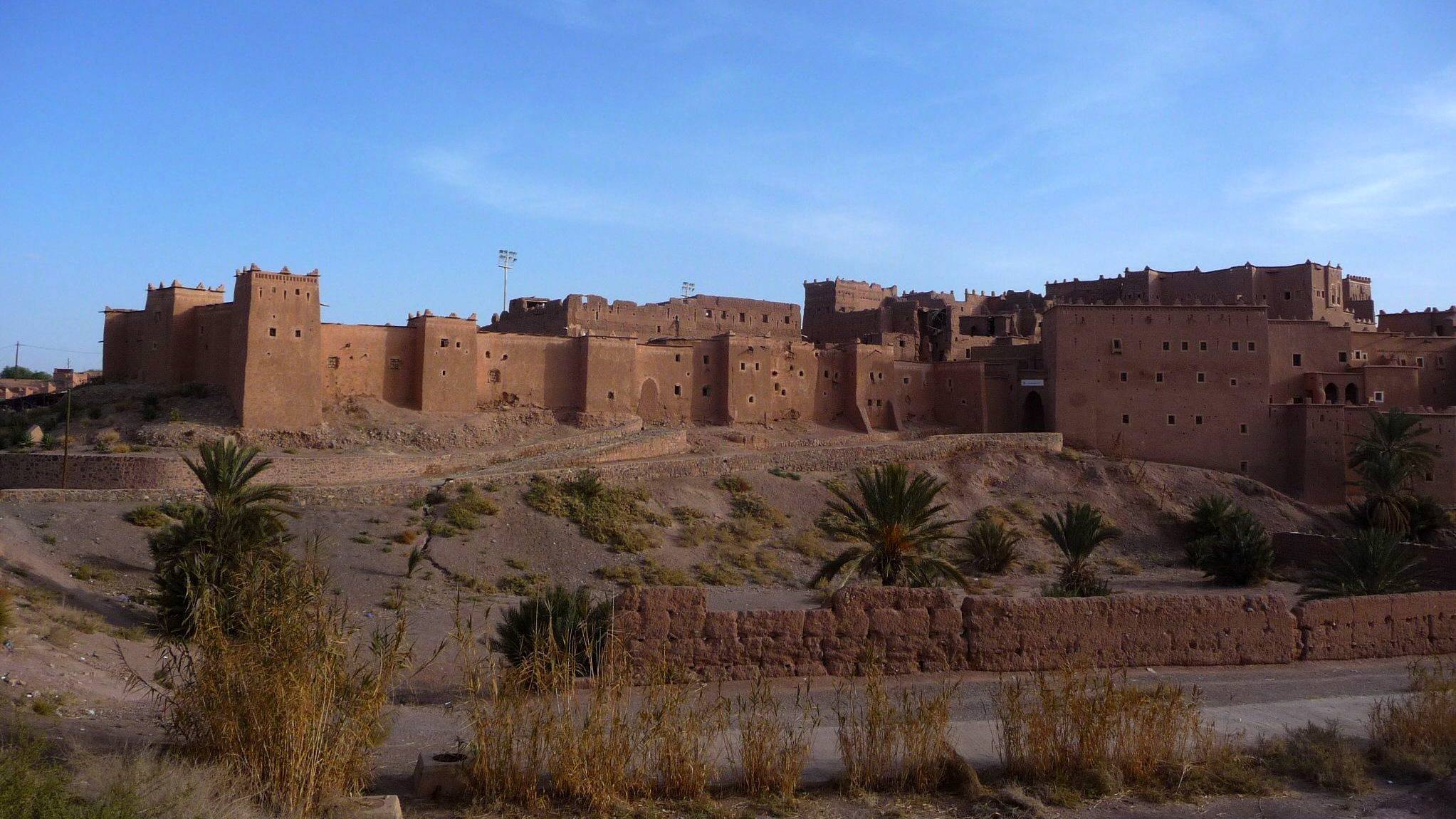 PopularMarrakech
5 Days Tour from Marrakech to Fes: Ait Ben Haddou, Dades and Two Nights in Merzouga
from €424 per person
 Marrakech
4 Days Morocco Tour: Marrakech, the High Atlas and Essaouira
from €327 per person