

About
Planning your first trip to Morocco? This ten-day itinerary covers the essentials – Marrakech, the desert and Fes – and explains what to expect along the way: how to handle the souks, what to wear, how much to tip, what the desert camp is like and how long the drives are. AT A GLANCE • Duration: 10 days, 9 nights • Start: Marrakech – Finish: Fes • Type: private tour with driver and local guides • Activity level: easy FIRST-TIME TIPS • Money: Moroccan dirhams; ATMs in cities; carry cash in the south. • Dress: light, modest clothing; a scarf is useful for sun, sand and mosques. • Souks: bargaining is normal and friendly; walk away politely if the price is wrong. • Tipping: customary for guides, drivers and camel handlers. • Safety: Morocco is generally safe; watch bags in crowds. WHO MIGHT PREFER ANOTHER TOUR For more freedom, see the Marrakech to Fes private road trip. PRACTICAL INFORMATION Ask us anything before you go.
from €908 per person
Select date and travelers
Duration
10 days
Starts in
Marrakech
Ends in
Fes
Private tourOnly your group, with your own driver and vehicle. Your booking is confirmed straight away.
Free cancellationFull refund if canceled up to 24 hours before the start of the experience (local time)
Reserve now and pay laterReserve your spot while maintaining flexibility.
Lowest price guaranteedFound a lower price online? We'll refund the difference.
Included
Everything included in your package
Standard
Private tour
- Comfortable Hotels or Riads
- Private Airport Transfers
- Private Transport Between Locations
- Daily Breakfast & Dinner
- Bottled Water During Travel
- Standard Room with Private Bathroom
LuxuryUpgrade
Private tour
- High-end Hotels or Riads
- Private Airport Transfers
- Personal Driver & Comfortable Transport
- Daily Breakfast & Dinner
- Bottled Water During Travel
- Private Room with En-suite Bathroom
- Luggage Assistance
- VIP Airport Meet & Greet
- Flexible Departure Times
- Complimentary Snacks During Travel
Itinerary: 10 days, day by day
Highlights
- Marrakech
- Ait Ben Haddou
- Ouarzazate
- Merzouga
- Dades Valley
- Midelt
- Ifrane
- Azrou
| Day | Route | Overnight | On the road |
|---|---|---|---|
| 1 | Welcome to Marrakech – The Gateway to Morocco | Marrakech | — |
| 2 | Explore the Magic of Marrakech | Marrakech | — |
| 3 | Marrakech - Ait Ben Haddou | Ait Ben Haddou | 130 km · 2 h |
| 4 | Ait Ben Haddou - Ouarzazate | Ouarzazate | 30 km · 1 h |
| 5 | Ouarzazate - Merzouga - Merzouga | Merzouga | 360 km · 5 h |
| 6 | Merzouga - Dades Valley | Dades Valley | 240 km · 3.5 h |
| 7 | Dades Valley - Midelt | Midelt | 220 km · 3 h |
| 8 | Midelt - Ifrane - Azrou - Fes | Fes | 240 km · 3.5 h |
| 9 | Fes – Exploring Morocco's Cultural Capital | Fes | — |
| 10 | Fes - Chefchaouen | — | 170 km · 2.5 h |
Day 1: Welcome to Marrakech – The Gateway to Morocco
Welcome to Morocco. Your driver meets you in the arrivals hall at Marrakech Menara airport holding a sign with your name and takes you to your riad in or near the medina, about 15 to 25 minutes away depending on traffic. Cars can't enter most of the old city's lanes, so a porter with a handcart usually walks your luggage the last few hundred metres; this is normal and part of arriving in Marrakech. A riad is a traditional house built around an inner courtyard, often with a fountain or orange trees, and quiet as soon as the door closes behind you. Your host will usually welcome you with mint tea and help you get your bearings on a small map. If you arrive in daylight, take a first, gentle walk: Jemaa el-Fna, the main square, is busiest after sunset, when food stalls, musicians and storytellers fill it. Eat at one of the numbered stalls where locals sit, and keep the evening short. Tomorrow is a full guided day, and the first night is for resting. FIRST-TIMER TIPS • Change a small amount of money at the airport (about 300–500 dirhams) for porters, tips and snacks; ATMs in the city give better rates. • Buy a local SIM or eSIM at the airport; maps and messaging make the medina much easier. • Friendly strangers offering to "show you the way" may expect payment; your riad can send someone to meet you instead. SCHEDULE (times are estimates) Arrival – Meet your driver at the airport +30 min – Check in to your riad and mint tea Evening – Optional walk to Jemaa el-Fna INCLUDED: airport transfer, riad night with breakfast. NOT INCLUDED: dinner, tips. Overnight: Marrakech (riad) Meals: breakfast (next morning)
Day 2: Explore the Magic of Marrakech
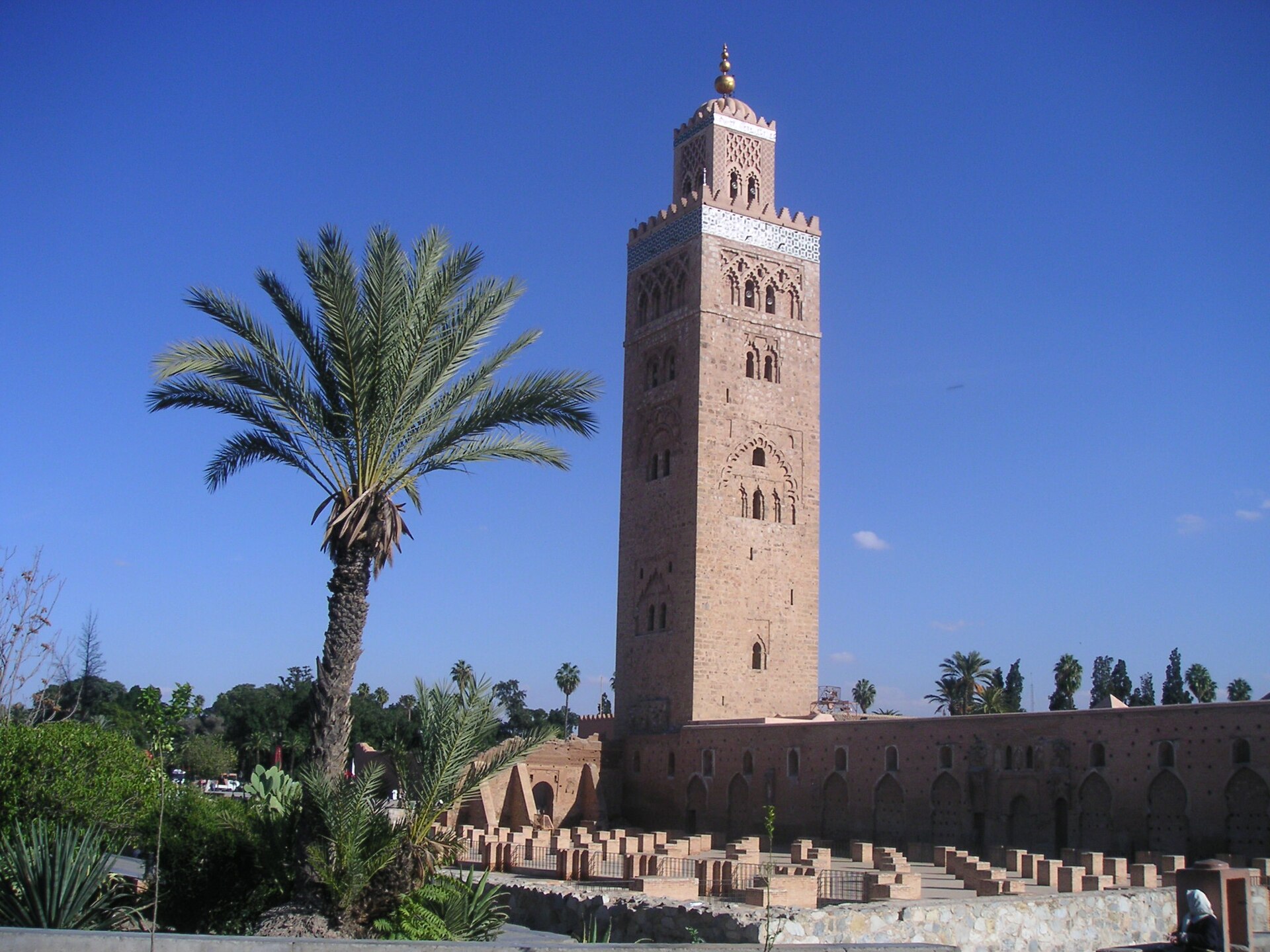
Today a licensed local guide shows you the Marrakech that first-time visitors come for, at a pace that leaves time to look around and ask questions. Begin at the Koutoubia mosque, whose 77-metre minaret has guided travellers into the city since the 12th century, then walk to the Saadian Tombs, the richly decorated burial place of a 16th-century dynasty, rediscovered only in 1917. Next comes the Bahia Palace, built for a grand vizier in the late 1800s, a sequence of courtyards, painted wooden ceilings and tiled rooms that shows how Morocco's elite lived. Your guide explains the symbols in the zellige tilework and the carved plaster, details most people walk straight past. After lunch, the guide takes you deep into the souks, the covered markets organised by craft: leather, lanterns, carpets, spices and woodwork. This is where you learn how bargaining really works, and where having a guide keeps the pace relaxed. End the day back at Jemaa el-Fna as the smoke rises from the grills and the square comes alive, ideally from a rooftop café with a view. FIRST-TIMER TIPS • In the souks, a first price may be two or three times the final one; smile, offer less and be ready to walk away politely. • Ask before photographing people, especially performers and stallholders in the square, who often expect a coin. • Most mosques in Morocco are closed to non-Muslims (the Hassan II mosque in Casablanca is a notable exception); you see the Koutoubia from its gardens. SCHEDULE (times are estimates) 09:00 – Koutoubia and its gardens 10:00 – Saadian Tombs 11:00 – Bahia Palace 13:00 – Lunch (not included) 14:30 – The souks with your guide 17:00 – Jemaa el-Fna at sunset INCLUDED: licensed guide, riad night with breakfast. NOT INCLUDED: entrance fees, lunch, tips. Overnight: Marrakech (riad) Meals: breakfast
Day 3: Journey through the Atlas Mountains to Ait Ben Haddou
About 130 km · 2 h on the road
Leave the city behind and head into the High Atlas, the mountain range that separates Marrakech from the desert. The road climbs through the Ourika foothills, past argan and walnut trees, to the Tizi n'Tichka pass at about 2,260 m, the highest paved pass in the country. On the way you stop at viewpoints over terraced valleys and earth-built Berber villages, and at a women's argan oil cooperative where you can see how the oil is pressed by hand. On the southern side, the landscape changes completely: green slopes give way to bare rock in shades of red, ochre and grey. In the early afternoon you reach Ait Ben Haddou, the UNESCO-listed ksar (fortified village) of earthen houses rising up a hill above the Ounila river. A local guide walks you across the river and through its lanes, past the old houses and the communal granary at the top, with views across the plain. Stay for the late-afternoon light, then check in to your hotel nearby. Dinner is included tonight, as it is on all your nights in the south, where restaurants are few and far between. FIRST-TIMER TIPS • The mountain road has many bends; sit in front if you get car-sick, and tell your driver if you need a break. • Bring a warm layer: it can be 10 °C colder at the pass than in Marrakech. • At the cooperative there is no obligation to buy; argan oil bought here is genuine, unlike many roadside bottles. SCHEDULE (times are estimates) 09:00 – Depart Marrakech 10:30 – Atlas viewpoints and argan cooperative 12:00 – Tizi n'Tichka pass 14:00 – Ait Ben Haddou; lunch (not included) 15:30 – Guided walk in the ksar INCLUDED: driver, local guide in Ait Ben Haddou, hotel with dinner and breakfast. NOT INCLUDED: lunch, drinks, tips. Overnight: Ait Ben Haddou (hotel) Meals: breakfast and dinner
Day 4: Discover Ouarzazate – Morocco's Desert Hollywood
About 30 km · 1 h on the road
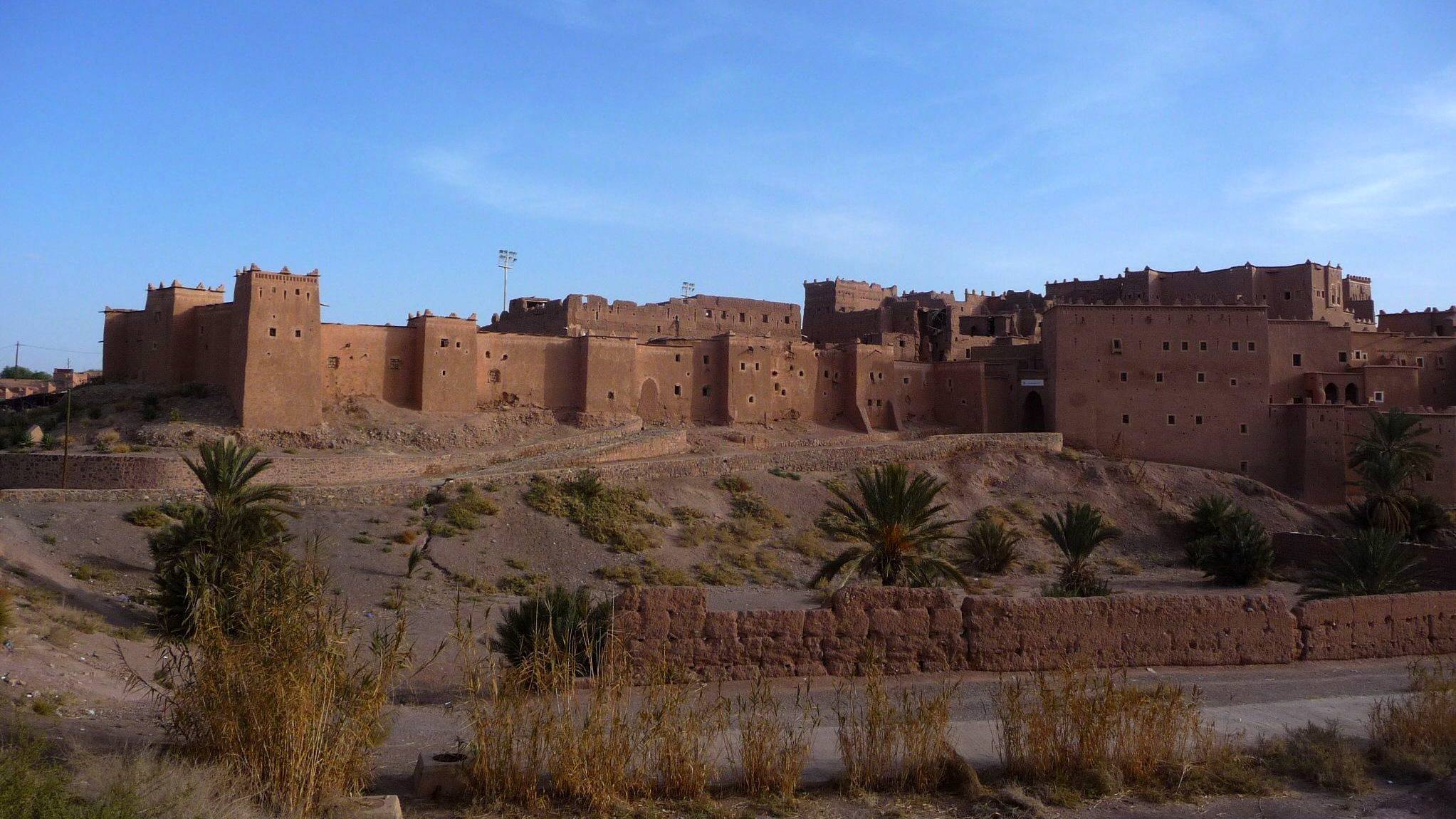
Ouarzazate has been called the Hollywood of the desert since the 1950s: the clear light, the empty landscapes and the old kasbahs have drawn film crews for decades, from Lawrence of Arabia to Gladiator and Kingdom of Heaven. This morning you visit one of the film studios on the edge of town, where sets of Egyptian temples, Roman arenas and Tibetan monasteries stand side by side in the sun; the guided tours tell the story behind the scenes. Later, visit the Taourirt Kasbah, the earthen palace of the Glaoui family, who ruled much of southern Morocco in the early 20th century. Its maze of courtyards, family rooms and painted ceilings gives a real sense of life in a southern kasbah, and the rooftop looks across the town to the mountains. The afternoon is slower: rest at your hotel's pool, wander the town's quiet market, or ask your driver to take you to the edge of the Fint oasis, a small green valley hidden among bare hills just outside town. This is a gentle day to recover from the drive over the Atlas and prepare for the long road to the desert tomorrow. FIRST-TIMER TIPS • Carry small change for entrance fees; card payment isn't always possible at monuments. • Light, long clothing protects from the sun better than shorts and vests, and is more comfortable in the heat. • This is a good moment to buy a scarf (chèche) for the desert; your driver can show you how to tie it. SCHEDULE (times are estimates) 09:00 – Film studios 11:00 – Taourirt Kasbah 13:00 – Lunch (not included) 15:00 – Free time or Fint oasis INCLUDED: driver, hotel with dinner and breakfast. NOT INCLUDED: entrance fees, lunch, tips. Overnight: Ouarzazate (hotel) Meals: breakfast and dinner
Day 5: Into the Sahara – Camel Trek in Merzouga
About 360 km · 5 h on the road
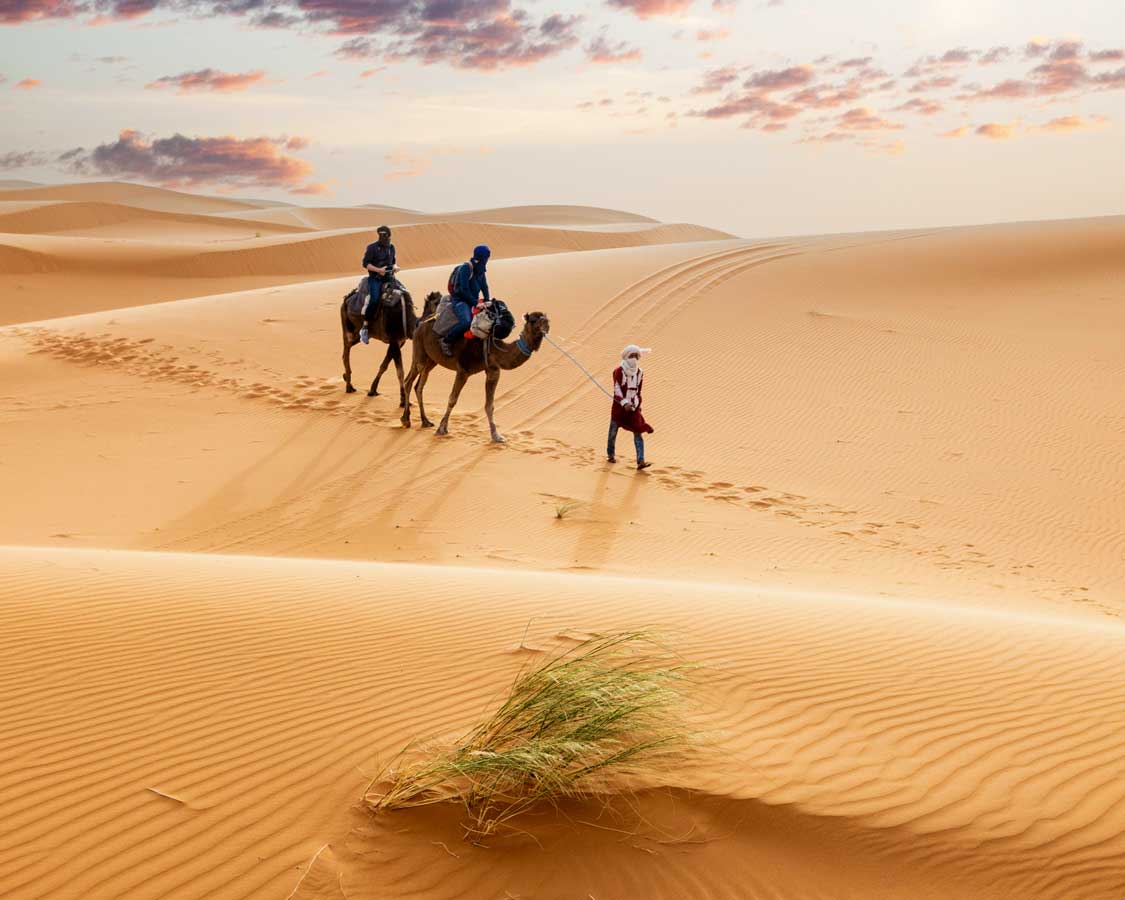
Today is the day most travellers remember: the road to the Sahara. Leave early and drive east along the Road of a Thousand Kasbahs, past the Skoura palm grove and through the Dades and Todra regions, where you stop for a short walk in the Todra Gorge, a narrow canyon with walls around 300 m high. Continue through Tinejdad and the oases of the Tafilalet to Merzouga, at the foot of the Erg Chebbi dunes. In the late afternoon, leave your main luggage in the car and meet your camel caravan. The trek into the dunes takes one to two hours, timed so you can watch the sun set from the top of a dune as the sand turns orange, then pink, then deep red. Your camp sits in a hollow among the dunes. After dinner, there is often music around the fire, and once the camp lights go out, the sky fills with more stars than most people have ever seen. Camps range from simple to comfortable, depending on the level you chose; all have beds, blankets and toilets. FIRST-TIMER TIPS • Bring a head torch and a warm layer for the camp; desert nights are cold from November to March. • Pack a small bag for the night (toiletries, charger, a change of clothes); your suitcase stays locked in the car. • On the camel, lean back going downhill and forward going uphill, and hold the handle; the guides lead the camels on foot. SCHEDULE (times are estimates) 07:30 – Depart Ouarzazate 10:30 – Todra Gorge 12:30 – Lunch (not included) 17:00 – Camel trek into the dunes 19:00 – Desert camp, dinner INCLUDED: driver, camel trek, desert camp with dinner and breakfast. NOT INCLUDED: lunch, drinks, tips. Overnight: Merzouga (desert camp) Meals: breakfast and dinner
Day 6: Sunrise in the Dunes and Drive to Dades Valley
About 240 km · 3.5 h on the road
Wake before dawn and climb the nearest dune to watch the sunrise over the Sahara, one of the quietest and most beautiful moments of the trip. After breakfast at camp, ride or walk back to Merzouga, take a shower at a partner hotel, and meet your driver. The road heads back west, with time to stop at places you passed quickly on the way out. In Rissani, the old caravan town, the market is lively on Sundays, Tuesdays and Thursdays. Then the route climbs into the Dades Valley, where the river has carved red and ochre cliffs and the road winds between fig trees, almond orchards and old kasbahs. You arrive in the Dades in the afternoon, in time to see the famous rock formations, nicknamed the "monkey fingers" and "the brain", and walk a little in the valley before dinner at your hotel. The contrast between the open desert in the morning and the green valley in the evening is one of the best things about this day. FIRST-TIMER TIPS • Ask before photographing people, especially women and children in villages; a smile and a gesture are enough. • Bring a reusable bottle; your driver can refill it, and it saves plastic in the desert. • If you buy fossils in the area, ask for the receipt in case customs asks about them. SCHEDULE (times are estimates) 06:00 – Sunrise on the dunes 08:00 – Breakfast and shower in Merzouga 09:30 – Depart, via Rissani 13:00 – Lunch (not included) 15:00 – Dades Valley INCLUDED: driver, hotel with dinner and breakfast. NOT INCLUDED: lunch, drinks, tips. Overnight: Dades Valley (hotel) Meals: breakfast and dinner
Day 7: From Dades to Midelt – Through the Heart of the Atlas
About 220 km · 3 h on the road
Today crosses the heart of Morocco, from the southern valleys to the foot of the Middle Atlas. Leave the Dades and drive through Tinghir, with its huge palm grove, then north across high plateaus where nomad families still graze sheep and goats and set up their tents in the cooler months. The road joins the Ziz Valley near Errachidia, a green ribbon of date palms deep in a red canyon, with viewpoints over the oasis and the Hassan Addakhil dam lake. Further north, the landscape opens into wide, empty plains, with the snow-capped peak of Jbel Ayachi (3,737 m) rising on the horizon. You reach Midelt in the late afternoon. This mountain town is known for its apples and for the minerals found in the area; small shops sell crystals and fossils at fair prices. It's a quiet, unhurried stop that breaks up the long journey north and gives you a feel for everyday Moroccan life away from the tourist routes. FIRST-TIMER TIPS • Long drive today: keep water, snacks, a charger and something to read in the car. • Public toilets are rare on the road; your driver stops at cafés where you can use them, and it's polite to buy a drink. • Midelt is higher than you'd expect (about 1,500 m) and cool in the evening, even in spring. SCHEDULE (times are estimates) 09:00 – Depart the Dades 10:00 – Tinghir viewpoint 12:30 – Ziz Valley; lunch (not included) 16:00 – Midelt INCLUDED: driver, hotel with dinner and breakfast. NOT INCLUDED: lunch, drinks, tips. Overnight: Midelt (hotel) Meals: breakfast and dinner
Day 8: Midelt to Ifrane & Azrou, Then Onward to Fes
About 240 km · 3.5 h on the road
This morning you cross the Middle Atlas, Morocco's greenest mountains. Between Midelt and Azrou, the road climbs into the cedar forest, home to the largest Atlas cedars in North Africa and to troops of Barbary macaques, the only wild monkeys in Africa north of the Sahara. You can watch them from a short distance at the forest's edge. Then stop in Ifrane, a town built in the 1930s in an Alpine style, with pitched roofs, chalets and tidy gardens. It's often called the Switzerland of Morocco and its stone lion statue is a favourite photo spot for Moroccan families. In winter there is sometimes snow, and ski slopes nearby. In the afternoon you reach Fes and check in to your riad. If you have energy, your driver can take you to the viewpoint at the Merinid Tombs above the city at sunset, when the call to prayer echoes across the rooftops of the medina, a good first look at the city you'll explore tomorrow. FIRST-TIMER TIPS • Don't feed the monkeys: it is bad for them, and they can snatch bags. • Fes medina is car-free; a porter will carry your bags from the car park to the riad. • Agree on taxi prices before getting in, or ask your riad to call a taxi for you. SCHEDULE (times are estimates) 09:00 – Depart Midelt 11:00 – Cedar forest and macaques 12:00 – Ifrane; lunch (not included) 15:00 – Fes, check in 18:00 – Optional: Merinid Tombs viewpoint INCLUDED: driver, riad night with breakfast. NOT INCLUDED: lunch, drinks, tips. Overnight: Fes (riad) Meals: breakfast
Day 9: Fes – Exploring Morocco's Cultural Capital
Fes is Morocco's spiritual and cultural capital, and its old city, Fes el-Bali, is one of the largest car-free urban areas in the world. Today a licensed guide leads you through it, and this is where having one matters most: the medina has thousands of lanes, and your guide turns a confusing maze into a story. Start at the golden doors of the Royal Palace and the Mellah, the old Jewish quarter with its wooden balconies. Enter the medina through Bab Boujloud, the blue gate, and visit the Bou Inania madrasa, with some of the finest woodcarving and tilework in the country. Walk past the Qarawiyyin, founded in 859 by a woman, Fatima al-Fihri, and see the al-Attarine madrasa next to it. In the afternoon, visit the workshops: weavers, coppersmiths and the famous Chouara tannery, where hides are dyed in round stone pits as they have been for centuries. You watch from a leather shop's terrace above. End with a mint tea and the chance to buy a souvenir made where you're standing. FIRST-TIMER TIPS • With a licensed guide, unofficial guides will leave you alone; without one, a polite "no, thank you" is enough. • Wear closed shoes: lanes can be wet or uneven. • At the tannery and in workshops, there's no obligation to buy; your guide earns no commission from you looking. SCHEDULE (times are estimates) 09:00 – Royal Palace and Mellah 10:00 – Bab Boujloud and Bou Inania 11:30 – Qarawiyyin and al-Attarine 13:00 – Lunch (not included) 14:30 – Craft workshops and Chouara tannery INCLUDED: licensed guide, riad night with breakfast. NOT INCLUDED: entrance fees, lunch, tips. Overnight: Fes (riad) Meals: breakfast
Day 10: Departure or Optional Extension to Chefchaouen
About 170 km · 2.5 h on the road
Your Moroccan adventure ends in Fes. After breakfast, your driver takes you to Fes-Saïss airport (about 30 minutes from the medina) or to the train station, from where fast and comfortable trains run to Rabat, Casablanca and Tangier. If you'd like more time, this is the easiest day to extend the trip. The most popular choice is Chefchaouen, the blue city in the Rif mountains, about four hours north of Fes, with one or two nights to wander its blue lanes and walk to the Spanish Mosque at sunset. Other options are a day in Meknes and the Roman ruins of Volubilis, or continuing to Tangier and crossing to Spain by ferry. Tell us when you book or during the trip, and we'll arrange it. Before leaving, take a last walk in the medina or have a final breakfast on your riad's roof terrace, and spend any remaining dirhams: you can't change them back outside Morocco. FIRST-TIMER TIPS • Check your flight time with your driver the day before, so the transfer is planned around it. • Moroccan dirhams can't be exchanged abroad; change them back at the airport or spend them before you go. • Keep receipts for larger purchases such as carpets, in case customs asks. SCHEDULE (times are estimates) Morning – Breakfast and check-out Morning – Transfer to Fes airport or train station INCLUDED: transfer to Fes airport or station. NOT INCLUDED: extension, lunch, tips. Overnight: not included (end of the tour) Meals: breakfast
Plan your trip
Best time to go
- March to May: the best season, warm days and green valleys.
- September to November: pleasant days and clear, starry desert nights.
- December to February: sunny days, but desert and mountain nights are cold (bring warm layers).
- June to August: very hot in the Sahara (often above 40 °C); early starts help.
Getting there
Make it yours
This is a private tour: we can add a night, change hotels or adjust the route to suit you.
Practical info
- Money: the Moroccan dirham (MAD). Cards work in cities and hotels; bring cash for villages, tips and souks.
- Plugs: type C and E (European), 220 V.
- Phone: a local SIM (Maroc Telecom, Orange or inwi) is cheap at the airport and works along the whole route.
- Visa: many nationalities (EU, UK, US, Canada, Australia) need none for up to 90 days. Check the rules for your passport before you go.
What to bring
- Comfortable shoes for the medinas and the dunes
- Warm layers for desert nights
- A scarf or hat, sunglasses and sunscreen
- Some cash in dirhams for tips and small purchases
- Clothes covering shoulders and knees for villages and religious sites
- Your passport (hotels ask for it at check-in)
Good to know
Cancellation policy
Full refund if you cancel at least 24 hours before the start. Cancellations less than 24 hours before are not refunded. If bad weather stops the tour, you get a new date or a full refund.
Accessibility
Not wheelchair accessible. Child seats or chairs available.
Frequently Asked Questions
Is this 10-day tour a good choice for a first trip to Morocco?
Yes, it was designed for it. In ten days you see the three places most first-time visitors want: Marrakech, the Sahara and Fes, plus the High Atlas, Ait Ben Haddou and the Dades Valley in between. Each day includes practical tips (money, dress, bargaining, tipping, photos), and you have a private driver and licensed guides in Marrakech and Fes, so you never have to figure things out on your own.
Is Morocco safe for first-time visitors?
Morocco is generally a safe country to travel in, and millions of visitors come every year. The main nuisances are pickpocketing in crowds and persistent sellers or unofficial guides in the medinas. With your own driver and licensed guides, most of that is taken care of. Use the same precautions as in any big city: keep valuables out of sight, use the hotel safe and agree on prices before buying.
Where does the tour start and end?
It starts in Marrakech, with a pick-up at Marrakech Menara airport on day 1, and ends in Fes on day 10, with a transfer to Fes-Saïss airport or the train station. This one-way route saves you the long drive back to Marrakech. If you need to fly home from Marrakech or Casablanca, ask us: we can end the tour there instead.
Is this a private tour?
Yes. Only you and the people you book with travel in the vehicle, with your own driver for the whole trip. You choose the start date, and the pace can change with you: more stops for photos, a longer lunch, a shorter walk. There is no minimum group size.
How many nights do I spend in the desert?
One night, in a desert camp among the Erg Chebbi dunes near Merzouga, on day 5. You arrive by camel at sunset and watch the sunrise from the dunes the next morning. If you'd like a second night in the desert, we can add it; it makes the long day 5 drive feel more relaxed.
What should I wear in Morocco?
Light, loose clothes that cover shoulders and knees are the most comfortable and respectful choice, for both men and women. A scarf is very useful for the sun, the sand in the desert and covering your shoulders. Bring comfortable closed shoes for the medinas, a warm layer for the Atlas and desert nights, and sunglasses and a hat. Swimwear is fine at hotel pools.
How much should I tip, and to whom?
Tipping is customary in Morocco and appreciated. As a guide, many travellers give local guides around 100–200 dirhams for a full day, camel handlers 50–100 dirhams, and their driver around 100–150 dirhams per day at the end of the trip. Porters and waiters receive small amounts (10–20 dirhams or about 10% at restaurants). It's always up to you; your driver can advise on the day.
What money should I bring, and can I pay by card?
Morocco uses the dirham (MAD), which you can't get before you arrive. ATMs are easy to find in Marrakech, Ouarzazate and Fes; withdraw enough cash for the desert and mountain days, where cards are rarely accepted. Hotels and larger shops take cards. Bring some euros or dollars as a back-up; they can be exchanged at banks and exchange offices.
Which meals are included?
Breakfast is included every morning. Dinner is included on the nights in Ait Ben Haddou, Ouarzazate, the desert camp, the Dades Valley and Midelt, where there are few restaurants. In Marrakech and Fes, dinner is not included, so you can try the many restaurants there. Lunches and drinks are not included; your driver stops at good local places.
How long are the drives?
Days 3, 5, 6 and 7 are the driving days, with 4 to 7 hours on the road, split into short sections by stops at viewpoints, villages and gorges. Day 5, from Ouarzazate to Merzouga, is the longest. Days 1, 2, 4, 9 and 10 have little or no driving. The vehicle is air-conditioned, and you can ask your driver to stop whenever you need to.
What kind of hotels are included?
You choose the level when you book. In Marrakech and Fes you stay in riads, traditional houses built around a courtyard, which are part of the experience. In the south you stay in comfortable hotels, often in restored kasbahs, and one night in a desert camp with beds and blankets. All rooms have a private bathroom, except in some simpler desert camps; choose the luxury level for a camp with en-suite bathrooms.
Can I extend the trip to Chefchaouen?
Yes, it's the most popular extension. Chefchaouen, the blue city, is about four hours north of Fes. Adding one or two nights there lets you wander its blue lanes and walk to the Spanish Mosque at sunset. We can also add Meknes and Volubilis, Rabat, or a drop-off in Tangier. Ask us when you book or during the trip.
When is the best time to do this tour?
Spring (March to May) and autumn (September to November) have the most comfortable weather everywhere on the route. Winter is sunny but cold in the Atlas and the desert at night, with occasional snow on the Tizi n'Tichka pass. Summer is very hot in the south and the desert; early starts help. During Ramadan, the tour runs as usual, although some restaurants close during the day.
How do I pay for this tour?
You can reserve with €20 now and pay the rest on the first day of the tour, or pay everything online when you book.
What is the cancellation policy?
Cancel at least 24 hours before the start for a full refund. If bad weather stops the tour, you get a new date or a full refund.
How far in advance should I book?
Spring (March to May) and autumn (September to November) are the busiest seasons, so book early for those months. You can reserve with €20 and still cancel for free up to 24 hours before.
Similar experiences
 PopularMarrakech
3-Day Marrakech to Merzouga Desert Tour with Sahara Camp
5.0(5)
from €276 per person
 PopularMarrakech
Morocco Itinerary 10 Days: The Grand Loop from Marrakech
from €908 per person
 PopularMarrakech
5 Days Tour from Marrakech to Fes: Ait Ben Haddou, Dades and Two Nights in Merzouga
from €424 per person
 Marrakech
4 Days Morocco Tour: Marrakech, the High Atlas and Essaouira
from €327 per person